 BestAIFor
The Potential Impact of Artificial Intelligence on Global Society Over the Next Five Years
A beginner-friendly look at how AI may reshape work, health, education, and governance from 2026 to 2031
February 17, 2026•9 min read
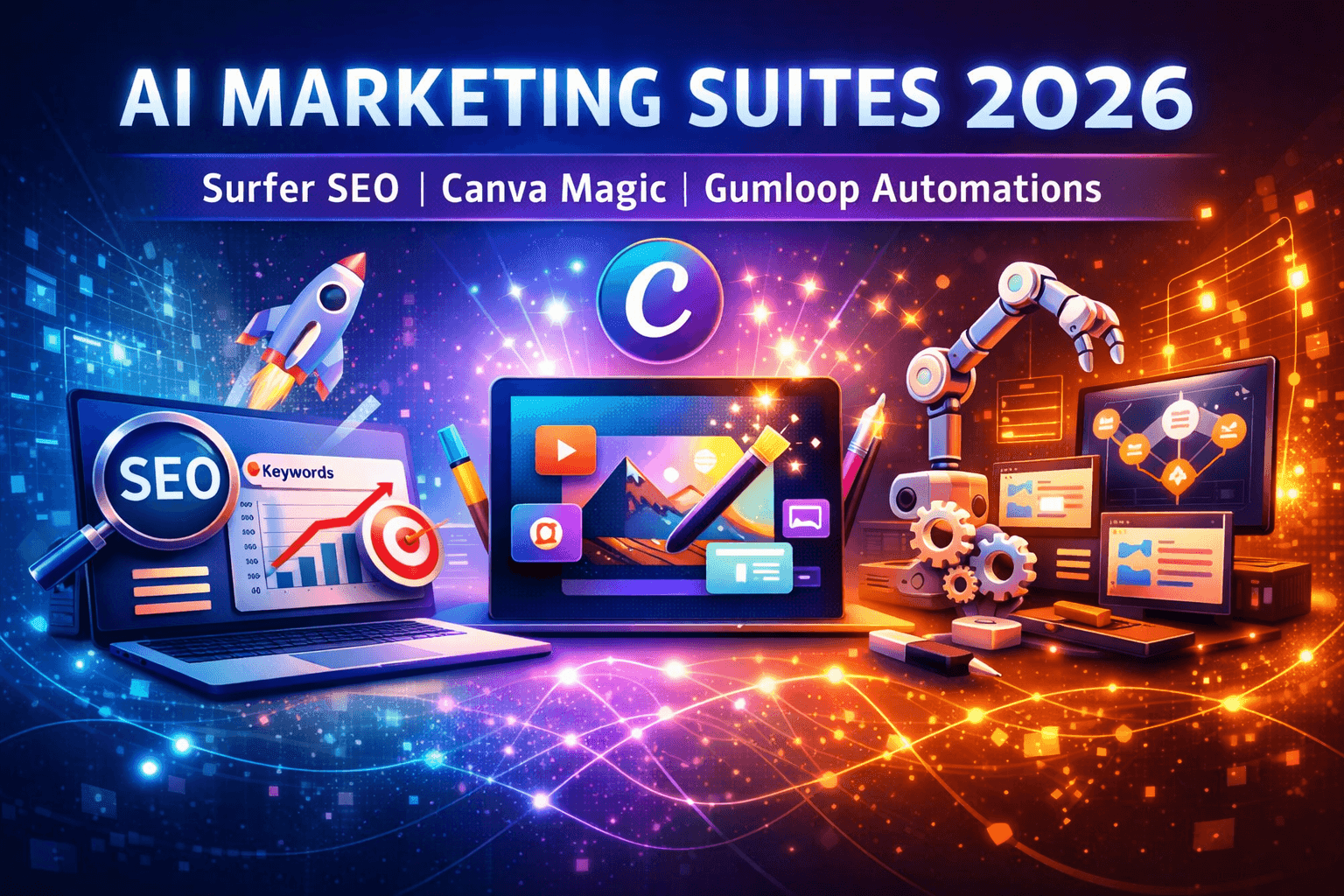
Search for “AI marketing tools 2026” and you’ll find hundreds of products promising dramatic gains. Most teams that chase those promises end up with overlapping subscriptions, manual workarounds, and unclear ROI. High-performing teams are shifting from collecting tools to designing AI marketing stacks that support real workflows end to end.
Instead of asking “Is this tool impressive?”, they ask:
That shift from tools to systems is what separates productive teams from bloated ones.
AI marketing stack (2026): a coordinated set of AI-powered tools and automations that work together across research, creation, distribution, and optimization rather than a collection of disconnected apps.
A practical stack usually includes three layers:
The goal is not maximum automation, but minimum friction.
This layer decides what to create and how to structure it so content ranks and converts. Modern SEO platforms analyze SERPs, competitors, and search intent to remove guesswork from planning.
For example, teams use tools like Surfer SEO to build data-backed content briefs and optimize pages before publishing, instead of retrofitting SEO later.
https://surferseo.com
Once direction is clear, teams need to produce on-brand visuals fast. AI-powered design platforms allow marketers not just designers to generate consistent assets for blogs, social posts, and ads.
A common pattern is using Canva AI to turn one article or campaign into a full set of visuals (hero image, social cards, simple diagrams) in a single session, all aligned to brand templates.
https://www.canva.com
The automation layer connects everything together. Instead of manual copy-paste work, AI workflows move content and data between tools, generate summaries, and trigger follow-ups.
Platforms like Gumloop are often used to monitor competitors, summarize new content with AI, repurpose articles into social or email drafts, and compile reports without writing code.
https://www.gumloop.com
Here’s what a realistic weekly SEO content workflow looks like with a stack-first mindset:
Plan with SEO intelligence
Research keywords, cluster topics, and generate a structured outline based on real SERP data.
Draft and optimize content
Write using SEO guidance so structure, headings, and terminology align with search intent from day one.
Produce visuals at scale
Generate blog headers and social graphics from the same content, using brand-safe templates.
Automate repurposing and reporting
Route the finished article into social drafts, email snippets, and a weekly performance summary automatically.
Each tool has a clear role. None overlap. That’s the difference between a stack and a mess.
| Approach | Strengths | Weaknesses | Best use case |
|---|---|---|---|
| Single AI tool | Fast to start | Becomes a bottleneck | Early experiments |
| Disconnected tools | Specialized features | Context switching | Ad-hoc teams |
| Integrated stack | End-to-end ROI | Requires planning | Growth teams |
| All-in-one suite | Simple UX | Vendor lock-in | Very small teams |
The objective is not to own more software, but to reduce effort per outcome.
Choose tools based on your biggest bottlenecks:
If a tool doesn’t clearly fix a bottleneck, it’s probably noise.
Before adding tools, make sure:
If most boxes are unchecked, focus on process clarity not new software.
The most common failures come from:
A simple rule helps: one primary tool per function, per layer.
You should pause new purchases if:
AI multiplies existing systems. If the system is broken, tools will amplify the damage.
Teams that win with AI in 2026 are not those with the most tools, but those with small, well-integrated AI marketing stacks. Anchor your setup around SEO intelligence, creative production, and automation then connect them with clear workflows.
Start with clarity, cut aggressively, and let AI support execution instead of adding chaos.
A beginner-friendly look at how AI may reshape work, health, education, and governance from 2026 to 2031

Why LLM Benchmarks Fail Your AI Agent (The 0.95^10 Problem)

EU Commission missed its February 2026 AI Act guidance deadline. EU Council now proposes pushing high-risk AI enforcement to December 2027. Only 8 of 27 member states have enforcement authorities in place.

Muck Rack's 2026 journalism survey found 82% of journalists use AI, up from 77%. But concern about unchecked AI rose 8 points to 26%. Here is what the numbers mean for editorial teams.

The News/Media Alliance signed a 50/50 AI licensing deal with Bria covering 2,200 publishers on enterprise RAG queries. The split sounds equitable. Bria controls the attribution algorithm.
The Dallas Fed's February 2026 analysis shows entry-level positions fell 16% in top AI-exposed industries while experienced workers' wages rose 16.7%. The split is structural, not temporary.

EU Digital Omnibus removes mandatory risk assessments for high-risk AI — including hiring tools — and delays August 2026 compliance with no fixed date. Amnesty calls it an unprecedented rollback of EU digital rights.

Tech firms blamed 47.9% of 78,557 Q1 2026 layoffs on AI. An NBER survey of roughly 6,000 executives found 90% reported no workforce impact. The gap matters, and this piece explains why.
AI-generated disinformation is hitting journalism at its most economically fragile moment in decades. The documented damage — contracting newsrooms, collapsing audience trust, synthetic content that outpaces...