What is agentglass?
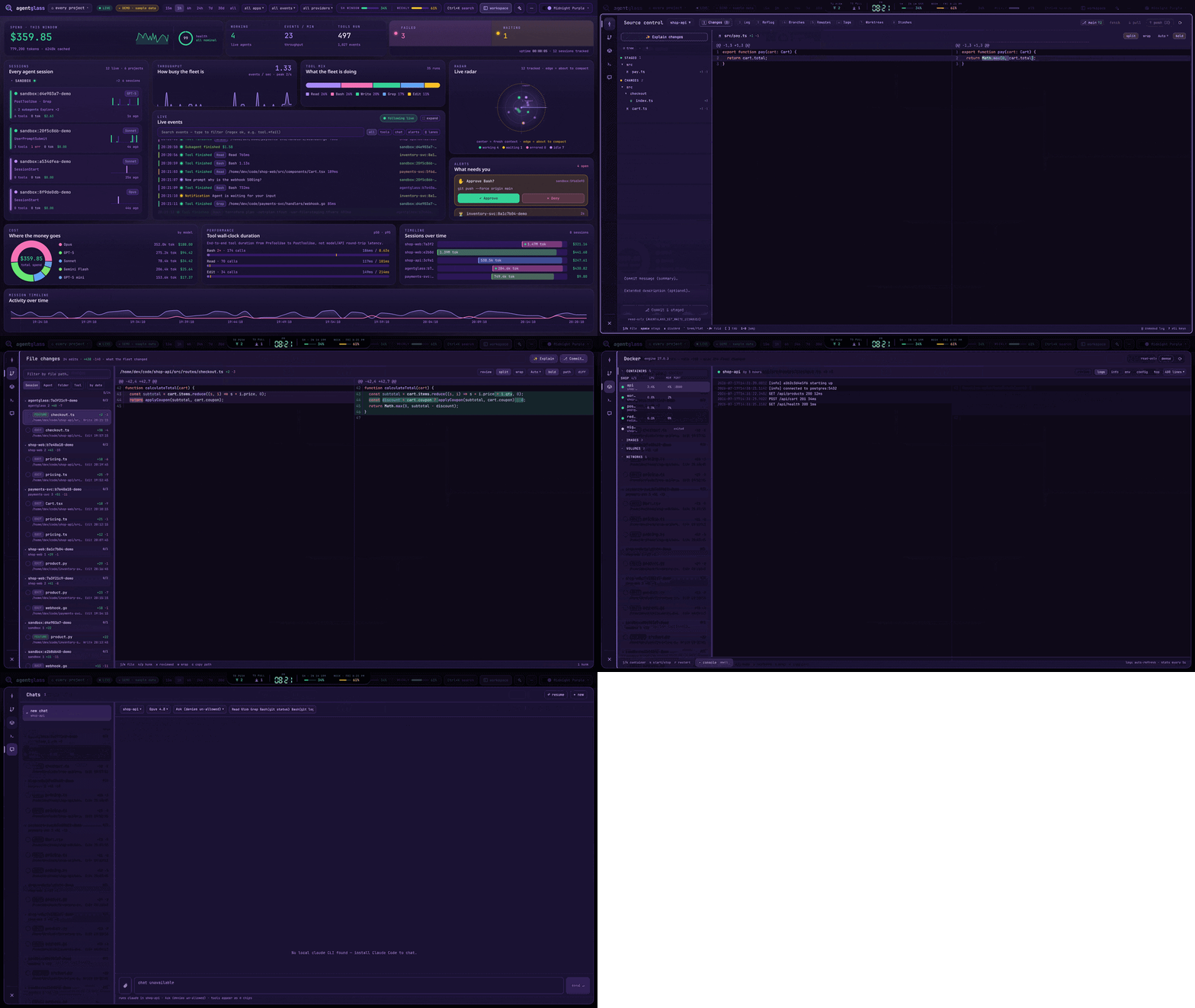
agentglass is an open-source AI agent observability tool that puts every AI coding agent running on your machine onto one screen, showing live tool calls, token usage, and cost side by side. It is built for developers who run multiple coding agents at once and lose track of what each one did across a dozen separate terminals. Instead of checking outcomes afterward, you watch each agent as a card that reports its model, current activity, cost, turns, and errors in real time. agentglass works across Claude Code, Codex, Gemini CLI, Kimi, and anything that emits OpenTelemetry, so it is not tied to a single provider. It is described as a workspace rather than just a dashboard: alongside monitoring, it bundles source control, diff review, pull requests, tasks, Docker, a terminal, chat, and a file browser behind keyboard shortcuts, and can hold a dangerous command until you approve it. The app runs locally, storing data in SQLite with loopback networking so nothing phones home, and is distributed as desktop installers for macOS, Linux, Windows, and Android. Built with Bun, SQLite, React, Vite, and Electron, agentglass is released under the MIT license, making it a self-hosted option for teams that want agent visibility without sending telemetry to a third party.
What is agentglass used for?
Best for developers running multiple terminal-based AI coding agents who want live, provider-agnostic visibility into tool calls, tokens, and cost on one screen.
How much does agentglass cost?
Pros and cons
Pros
- Shows every running agent on one screen as live cards with model, current activity, cost, turns, and errors
- Provider-agnostic: works with Claude Code, Codex, Gemini CLI, Kimi, and anything that emits OpenTelemetry
- Can hold a dangerous command until you explicitly approve it
- Local-first with SQLite storage and loopback networking, so nothing phones home
- Open source (MIT) with desktop installers for macOS, Linux, Windows, and Android
Cons
- Aimed at terminal/CLI coding agents rather than general-purpose or production LLM apps
- Non-OpenTelemetry agents may need extra setup to surface data
- As a self-hosted desktop app, it lacks the hosted multi-user features of SaaS observability platforms
- Early-stage single-maker open-source project, so support and roadmap depend on the community
Questions about agentglass
What is agentglass used for?
agentglass is used to monitor and control multiple AI coding agents at once. It shows every agent running on your machine on one screen with live tool calls, token usage, and cost, so you can see what each agent is doing, spot one stuck in a loop, and hold a dangerous command until you approve it, instead of finding out what happened afterward.
Is agentglass free?
Yes. agentglass is free and open source under the MIT license, and it is distributed as desktop installers for macOS, Linux, Windows, and Android. No paid tiers or subscription pricing are published.
Which AI coding agents does agentglass support?
agentglass works across Claude Code, Codex, Gemini CLI, Kimi, and anything that speaks OpenTelemetry. Because it reads OpenTelemetry, it is not tied to a single provider and can display agents from different vendors together on one screen.
Is agentglass a dashboard or a workspace?
agentglass describes itself as a workspace, not just a dashboard. Beyond live monitoring, it bundles source control, diff review, pull requests, tasks, Docker, a terminal, chat, and a file browser behind keyboard shortcuts, and it can gate dangerous commands for approval.
Does agentglass send my data to the cloud?
No. agentglass is local-first: it stores data in SQLite and uses loopback networking so nothing phones home. That makes it a self-hosted option for teams that want agent visibility without sending telemetry to a third party.
What are the best alternatives to agentglass?
Reviews
Sign in to rate and review agentglass.
Sign in to reviewNo reviews yet. Be the first to review agentglass!