What is ClinicalTrial OS?
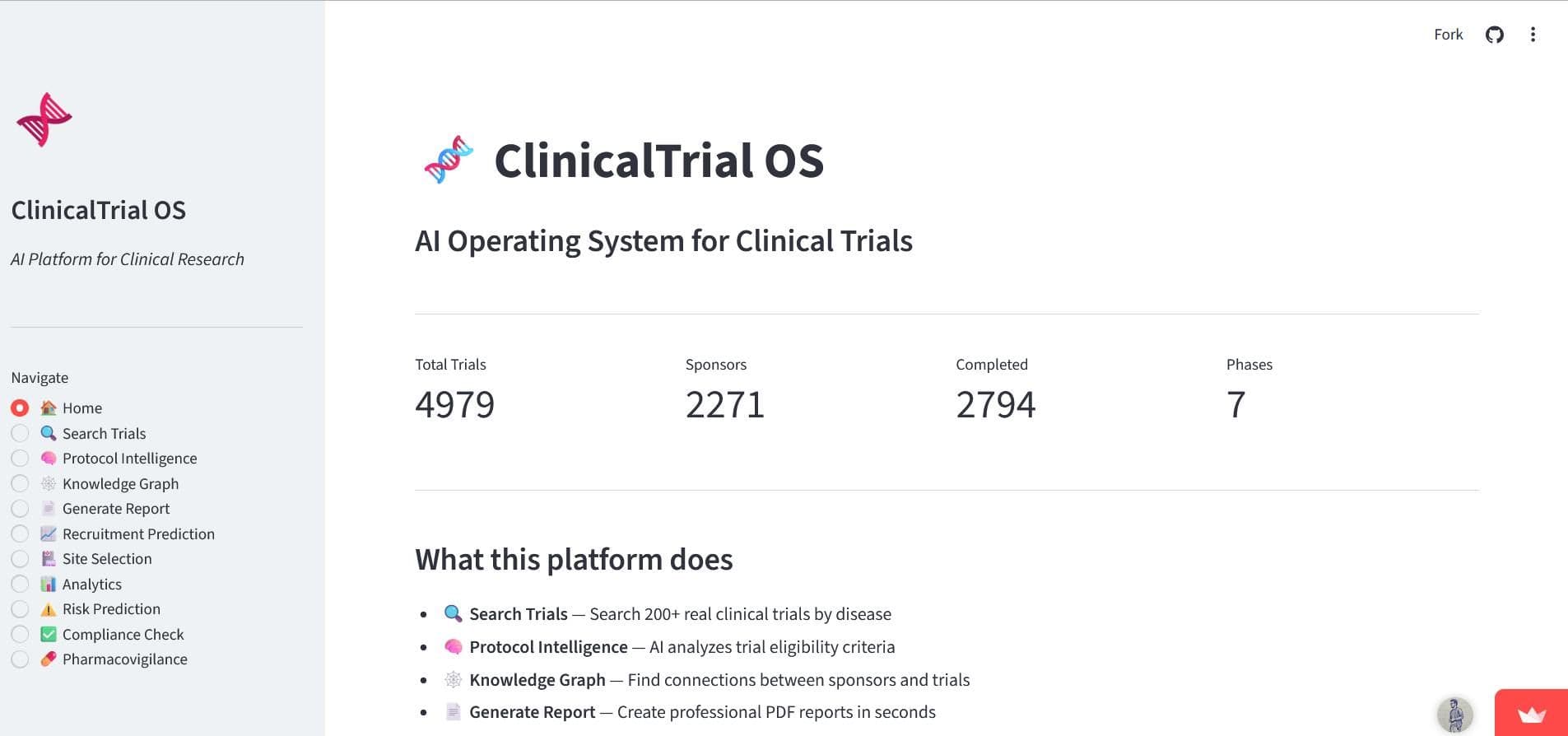
ClinicalTrial OS is an open-source AI research tool that helps clinical trial planners and healthcare researchers analyze the trial landscape and pick sites using public data from ClinicalTrials.gov and the FDA. You search by drug, sponsor, condition, or NCT ID and open a full trial detail view, then the platform splits eligibility criteria into inclusion and exclusion lists and scores each trial's complexity against peer trials. It ranks real trial sites by their experience, completion rate, and current activity, runs an early-stop risk model trained on finished trials, and applies a 23-point registry quality and transparency check. A knowledge-graph view, recruitment prediction, and adverse-event tracking round out the analysis. The app is built in Python with Streamlit, SQLite, pandas, scikit-learn, NetworkX, Plotly, and ReportLab, and is released under an MIT license; optional AI features need a free Groq API key or a local Ollama setup. The hosted demo covers 4,785 trials across 10 disease areas and 32,498 sites worldwide. The project states it is for research and educational use only, not regulatory or medical advice. For teams weighing the best AI for clinical trial feasibility work, BestAIFor lists it as a free, self-hostable option among AI research tools.
What is ClinicalTrial OS used for?
Clinical trial feasibility, eligibility complexity scoring, and site selection from ClinicalTrials.gov and FDA data
How much does ClinicalTrial OS cost?
Free
Free and open source (MIT license) — optional AI features need a free Groq API key or local Ollama
Pros and cons
Pros
- Splits eligibility into inclusion/exclusion and scores trial complexity against peers
- Ranks real trial sites by experience, completion rate, and current activity
- Early-stop risk model trained on finished trials
- 23-point registry quality and transparency check
- MIT-licensed and self-hostable, with optional AI via a free Groq key or local Ollama
Cons
- Explicitly for research and educational use only, not regulatory or medical advice
- Hosted demo is limited to 4,785 trials across 10 disease areas
- AI features require setting up a Groq API key or local Ollama
- Runs on Streamlit, so it is a demo-grade app rather than a hardened enterprise product
Questions about ClinicalTrial OS
What is ClinicalTrial OS used for?
It is used to analyze the clinical trial landscape from ClinicalTrials.gov and FDA data: searching trials, scoring eligibility complexity, ranking candidate sites, estimating early-stop risk, and checking registry quality.
Is ClinicalTrial OS free?
Yes. It is released under an MIT license at no cost. Optional AI features require a free Groq API key or a local Ollama install.
What is ClinicalTrial OS built with?
It is built in Python using Streamlit, SQLite, pandas, scikit-learn, NetworkX, Plotly, and ReportLab, and can be run from the hosted Streamlit demo or self-hosted.
Can ClinicalTrial OS be used for medical or regulatory decisions?
No. The project states it is for research and educational use only and is not a substitute for regulatory or medical advice.
What are the best alternatives to ClinicalTrial OS?
OpenClinica and ClinicalTrials.gov search tools
Reviews
Sign in to rate and review ClinicalTrial OS.
Sign in to reviewNo reviews yet. Be the first to review ClinicalTrial OS!