What is Model Boss?
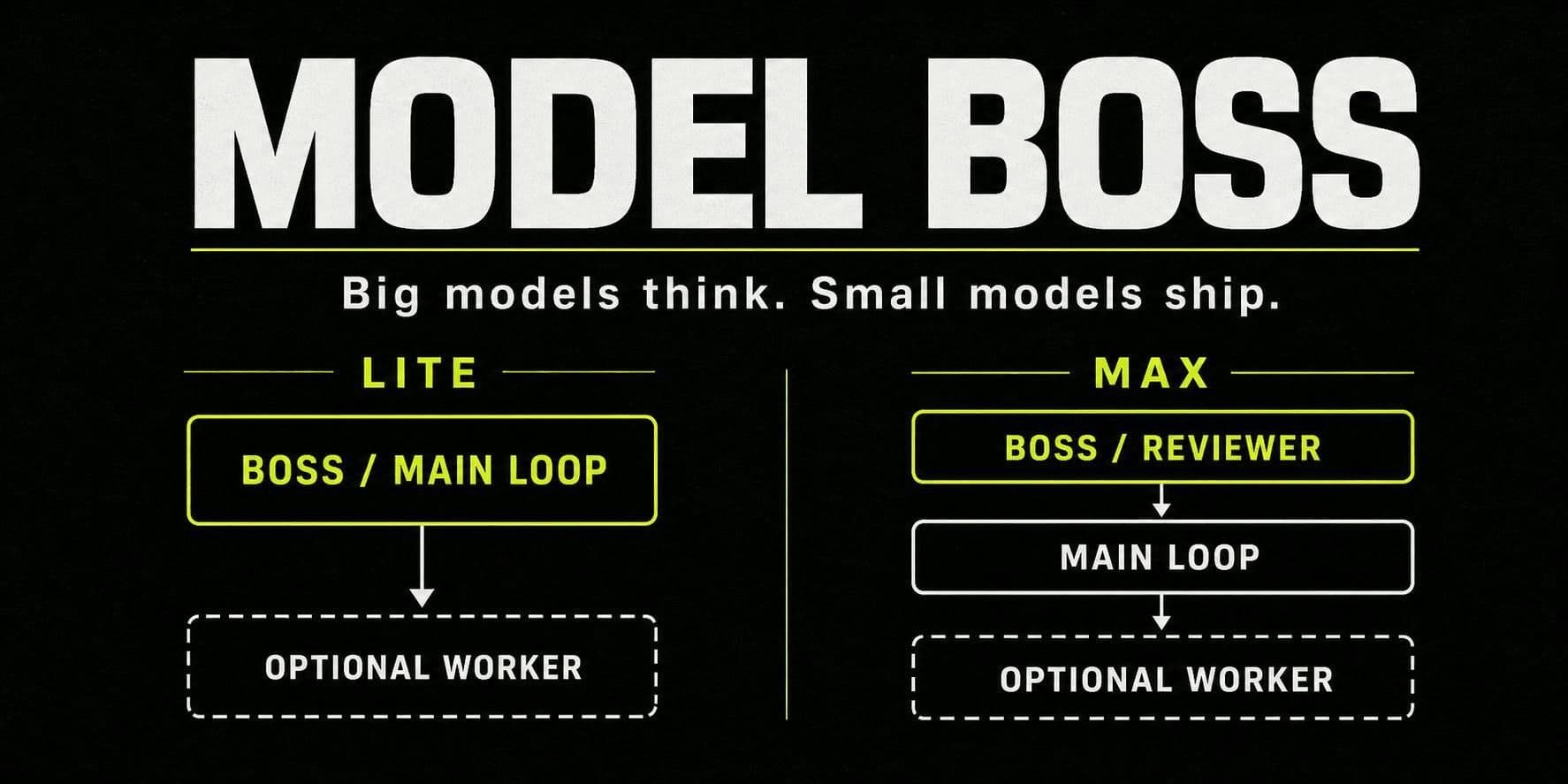
Model Boss is an AI coding-agent orchestrator that coordinates Claude Code and Codex across multiple models so developers can delegate bounded implementation work to lower-cost worker models while a stronger model approves plans and final evidence. The host-selected main conversation loop stays immutable, and external workers receive sealed task packets in disposable git worktrees rather than the full conversation history. Write-capable routes run under OS sandboxing (macOS sandbox-exec, Linux bwrap, or WSL), and workers are limited to Read, Glob, Grep, Edit, and Write tools with Bash, Web, and MCP access disabled. Approvals are hash-bound: final sign-off is tied to the source snapshot, worker delta, and projected task patch hashes, so stale approvals are rejected. It offers two topologies: Lite, where authority stays in the main loop with an optional worker, and Max, which requires a distinct external reviewer that checks worker claims against independently captured process and Git evidence. Safety gates cap self-healing at three attempts and revision rounds at two. Models are declared as authority, balanced, or fast and verified live before dispatch, with support for Claude models (Opus, Sonnet, Haiku, Fable) and Codex tiers, plus Kimi and GLM through verified wrappers. It is aimed at engineers running multi-file implementations, migrations, and mechanical refactors with testable acceptance criteria, and steps aside for tiny single-file edits or pure discussion.
What is Model Boss used for?
Best for developers who want to delegate bounded, multi-file coding tasks to lower-cost AI worker models while a stronger model reviews and approves the results.
How much does Model Boss cost?
Plan
Underlying model usage (Claude Code / Codex subscriptions or API) is billed separately by those providers
Plan
Effort levels (low/medium/high/max/xhigh) and topology (Lite vs Max) control how much model spend a task incurs; an estimate command prices approaches inline before running
Pros and cons
Pros
- Keeps API spend down by routing bounded implementation work to lower-cost worker models while reserving a stronger model for approval
- Runs write-capable workers in disposable git worktrees under OS sandboxing (sandbox-exec, bwrap, or WSL) so the source repo is not mutated directly
- Hash-bound approvals tie final sign-off to source, delta, and patch hashes, rejecting stale approvals
- Restricts workers to Read/Glob/Grep/Edit/Write and disables Bash, Web, and MCP, plus caps self-healing and revision rounds
- MIT-licensed and free to install as a Claude Code or Codex skill
Cons
- Requires Python 3.11+, Git, and a sandbox binary (sandbox-exec on macOS or bwrap on Linux); native Windows uses native agents instead of sandboxed workers
- You still pay the underlying Claude Code and Codex model usage costs; the tool controls spend but does not eliminate it
- Command-line and skill-based setup with topology and effort configuration adds a learning curve
- Not suited to small single-file edits, judgment-dense work, or low-latency interactive sessions
Questions about Model Boss
What does Model Boss do?
Model Boss is a cross-model orchestration tool for Claude Code and Codex. It lets a strong model plan and approve work while cheaper worker models carry out bounded implementation tasks in disposable git worktrees, with sandboxing, tool limits, hash-bound approvals, and test gates.
How does Model Boss keep AI-generated code changes safe?
Write-capable workers run in disposable git worktrees under OS sandboxing (sandbox-exec on macOS, bwrap on Linux, or WSL), are limited to Read, Glob, Grep, Edit, and Write tools with Bash/Web/MCP disabled, and their output is validated. Final approval is hash-bound to the source snapshot, worker delta, and projected patch, and stale approvals are rejected.
Which AI models does Model Boss support?
It supports Claude models via Claude Code (including Opus, Sonnet, Haiku, and Fable tiers) and OpenAI Codex tiers, plus external routes such as Kimi and GLM through verified wrappers. Models are declared as authority, balanced, or fast and are verified live before work is dispatched.
How much does Model Boss cost?
Model Boss itself is free and open source under the MIT license. You still pay for the underlying Claude Code and Codex model usage separately. Effort levels and the Lite versus Max topology let you control how much model spend each task uses, and an estimate command prices the options before you run.
When should I not use Model Boss?
It is not intended for small single-file edits, pure discussion, judgment-dense work, or interactive single-stream sessions that need low latency. It fits bounded, multi-file tasks such as implementations, migrations, and mechanical refactors with testable acceptance criteria.
What are the best alternatives to Model Boss?
Reviews
Sign in to rate and review Model Boss.
Sign in to reviewNo reviews yet. Be the first to review Model Boss!