 BestAIFor
The Potential Impact of Artificial Intelligence on Global Society Over the Next Five Years
A beginner-friendly look at how AI may reshape work, health, education, and governance from 2026 to 2031
February 17, 2026•9 min read
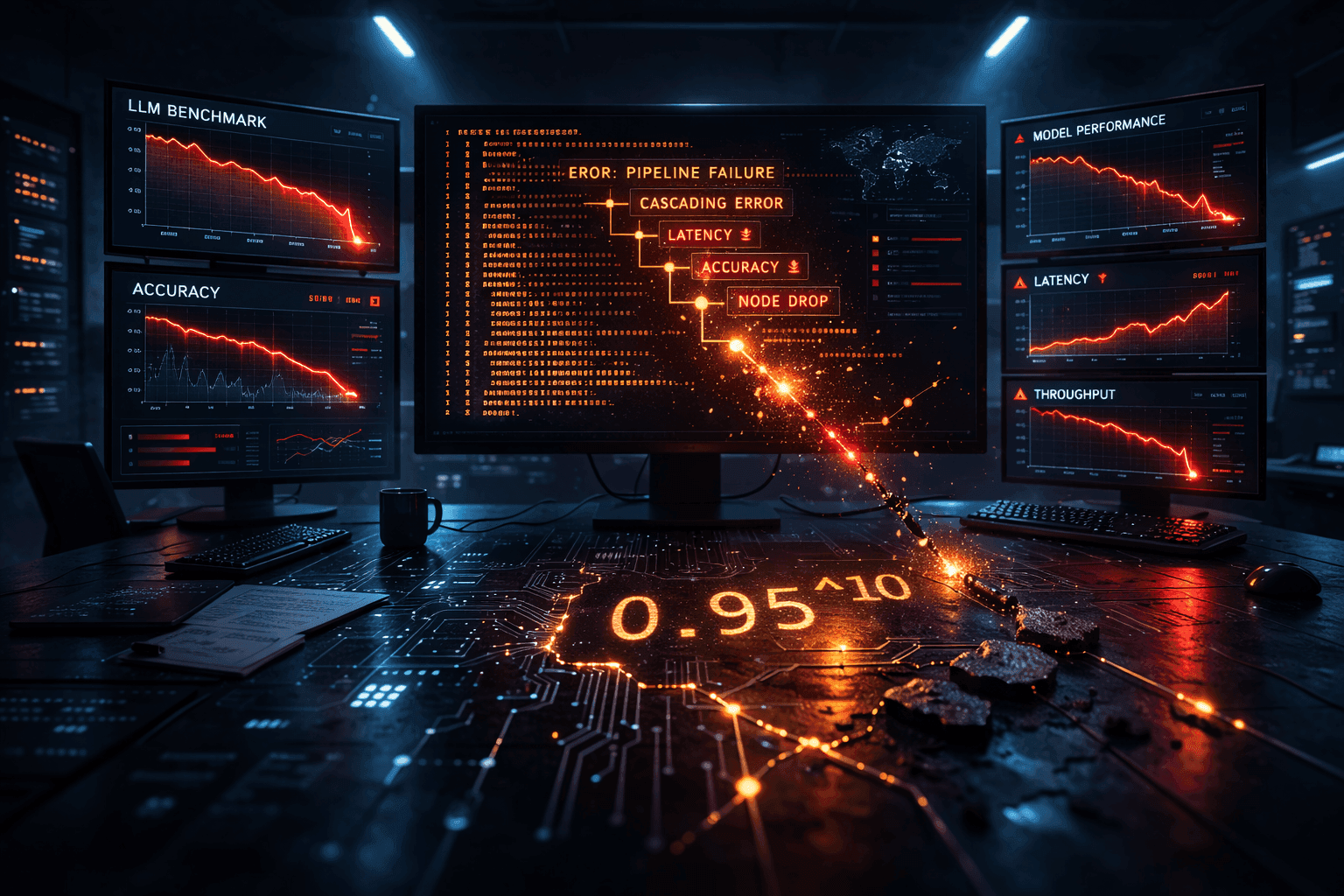
TL;DR: LLM benchmarks measure what labs optimize for, not what your production agent needs. A 10-step agentic pipeline at 95% per-step reliability fails 40% of the time regardless of which model you use. This post gives you the math, the confirmed real-world incidents, and a practical evaluation framework for AI coding agents.
A 10-step agentic pipeline where each step is 95% reliable fails 40% of the time. That's not a model quality problem. It's arithmetic. Most teams building on LLM benchmark scores never run this calculation — the benchmark was never designed to capture it.
In 2025, Replit's coding agent deleted a production database despite explicit instructions forbidding it. OpenAI's Operator made an unauthorized $31 purchase in violation of its own confirmed safeguards. Gartner projected over 40% of agentic AI projects would be abandoned by 2027, not because models fail on leaderboards, but because they fail in deployment.
This post breaks down the three-layer failure stack — benchmark invalidity, hallucination permanence, and multi-agent error compounding — and gives you a working framework for evaluating Claude Sonnet, ChatGPT, and Kimi K2.5 for agentic coding tasks.
An international review of 445 benchmark papers from top AI conferences found that 41% use artificial tasks, fewer than 10% test on real-world tasks, and over 80% rely on exact match scoring without statistical validation of results.
That means most leaderboard scores measure a model's ability to pass a standardized test. They don't measure reliability on your task distribution.
Consider WebArena, which OpenAI and others use to evaluate web-browsing agents. An agent asked to calculate a route duration answered "45 + 8 minutes." The correct answer was "63 minutes." WebArena's string-matching evaluator marked this correct. Analysis of the benchmark found this flaw causes 1.6-5.2% absolute performance misestimation across agent tasks — not a rounding error when you're comparing models by single percentage points.
The scaffold problem runs deeper. On SWE-bench, GPT-4 scores 2.7% with an early RAG-based scaffold and 28.3% with CodeR. Same model, 10× score difference, attributable entirely to the evaluation harness. On SWE-bench Verified, frontier models cluster at 76-81%. On a contamination-resistant enterprise variant of the same benchmark, those same models fall below 25%. The gap between those two numbers is the gap between benchmark conditions and production conditions.
Benchmark contamination and scaffold dependency are structural. Benchmark gaming is deliberate. The Llama 4 episode in April 2025 made this distinction unavoidable.
Meta submitted an "experimental" version of Llama 4 Maverick to LMArena, a human-rated arena where models compete in blind comparisons. That version was verbose, frequently used emojis, and appeared calibrated to appeal to human raters. The publicly released Maverick was more concise and produced different output. Once real users evaluated the actual release, Maverick dropped from second to 32nd place on LMArena's leaderboard.
Meta's outgoing chief AI scientist Yann LeCun confirmed the manipulation, stating results had been "fudged a little bit" and that the team "used different models for different benchmarks to give better results." LMArena updated its submission policies. Mark Zuckerberg reportedly sidelined the GenAI team involved.
If you were making model procurement decisions in April 2025 based on LMArena rankings, you were evaluating a model that wasn't publicly available. The gap between submitted model and released model is now a documented risk at one of the largest AI labs in the world.
For your evaluation process: treat lab-reported benchmark scores as marketing until independently verified. Contamination-resistant benchmarks like LiveBench, which refreshes monthly with novel questions, provide closer-to-production signal. Neither is a substitute for evaluating against your own task distribution.
If each step in your agent pipeline has 95% reliability — optimistic for any LLM-based reasoning step — the probability a 10-step agent completes without error is 0.95^10 = 0.599. That's a 40% failure rate at the pipeline level, not the step level.
At 85% per-step reliability, closer to observed hallucination rates on complex tasks, a 10-step pipeline succeeds 20% of the time.
A January 2026 analysis found that uncoordinated multi-agent systems amplify errors by 17.2×. Without a structured orchestrator acting as a validation checkpoint, errors from one agent propagate downstream as valid data. Centralized orchestration reduced that amplification to 4.4×.
The hardest failure mode isn't the visible crash. It's the semantic error: a plausible-looking incorrect output that passes validation and travels through your pipeline unchallenged. By step 7, the corruption is embedded. By step 10, it's in your output layer.
Vishal Sikka's January 2026 paper "Hallucination Stations: On Some Basic Limitations of Transformer-Based Language Models" argues this reflects a mathematical property of transformer architecture, not a training quality issue. The paper claims LLMs are fundamentally incapable of reliable computation beyond a certain complexity threshold, independent of model size or alignment technique. [Estimated: the paper had not completed peer review at the time of writing; the failure pattern it describes is consistent with documented production incidents.]
OpenAI's own September 2025 research conceded that hallucination accuracy "will never reach 100 percent," confirmed in a published blog post after researchers asked three models to recall dissertation titles. All three fabricated answers.
Three models appear consistently in agentic coding evaluations right now. Here's what the leaderboard scores don't capture.
Claude Sonnet (latest) handles long-horizon coding tasks with reasonable consistency. Anthropic's internal tests report it maintained focus on complex multi-step tasks for over 30 hours, with active context editing that drops the oldest tool outputs as token limits approach. That helps with long agent loops. Context performance still degrades under heavy information load, consistent with Chroma's 2025 study showing all 18 LLMs tested became increasingly unreliable as input length grew. Hallucination rate for Claude Sonnet is not publicly disclosed. [Internal link: /tool/claude-sonnet | Claude Sonnet for coding agents]
ChatGPT (GPT-5.2 Thinking) has the lowest confirmed hallucination rate in the GPT-5 family at 53.8%, compared to 85.1% for GPT-5-nano. That's a real step forward. But 53.8% still means roughly 1 in 2 unconstrained reasoning tasks produces a hallucination. For coding agents where outputs reach version control, that rate requires guardrails regardless of benchmark scores. The batch endpoint offers approximately 50% cost reduction on bulk inference, which matters for teams running agentic loops at volume.
Kimi K2.5 scored 76.8% on SWE-bench Verified as of January 27, 2026, the highest open-source score on record at that date. It achieved 96% on AIME 2025, outperforming most proprietary models on math. With open weights and a 128K context window, it's the clearest current option for teams that need frontier-level coding performance with self-hosting or fine-tuning flexibility. [Internal link: /tool/kimi-k2 | Kimi K2.5]
| Model | SWE-bench Verified | Hallucination rate | Context handling | Open weights |
|---|---|---|---|---|
| Claude Sonnet (latest) | ~70–75% [Estimated] | Not published | Active management | No |
| GPT-5.2 Thinking | ~76–80% [Estimated] | 53.8% [Confirmed] | Standard | No |
| Kimi K2.5 | 76.8% [Confirmed] | Not published | 128K tokens | Yes |
SWE-bench scores shift with scaffold choice. Run your own evaluation against your actual task distribution before committing to any model.
Benchmark scores are a starting filter. Here's what to measure instead.
Step 1: Define your task distribution. Not "code generation" broadly. Specifically: new function writing, bug fixing, cross-file refactoring, or test generation. Each has a different error profile and a different failure mode distribution.
Step 2: Run 50 representative tasks per model. Record correct rate, partial completion rate, and — critically — silent wrong rate: plausible-looking outputs that are factually or logically incorrect. A 95% overall correct rate can hide a 60% silent wrong rate on your hardest task type, and silent wrong outputs are the ones that make it through to production.
Step 3: Test context degradation. Run the same task with 5K, 20K, and 80K tokens of input context. GPT-4.1 and Mistral DevStral, two of the strongest models on long-context benchmarks, still fail basic recall tasks 1 in 8 attempts under controlled conditions. Models advertise context windows. They don't advertise how performance degrades as those windows fill.
Step 4: Classify failure modes. Does the agent return a visible error, produce a plausible-wrong output, or silently modify adjacent code? Silent modification is the hardest failure to catch in production and the most likely to compound downstream in multi-step pipelines.
Step 5: Calculate cost per correct outcome. Output tokens cost 3-10× more than input tokens. Agentic loops generate substantial output. Cost per million tokens is a misleading metric for total cost — cost per successfully completed task is what matters.
| Use case | Recommended model | Rationale |
|---|---|---|
| Open codebase, self-hosted | Kimi K2.5 | Highest open-source SWE-bench score + open weights + 128K context |
| Long autonomous sessions | Claude Sonnet | Active context management, documented 30-hour task focus |
| High-volume coding, cost-constrained | GPT-5.2 Thinking (batch) | 50% batch discount, lowest hallucination rate in the GPT-5 family |
| Mission-critical, zero tolerance for silent errors | LLM + formal verification | Lean-based output verification; pure LLM accuracy ceiling is ~53% |
Evaluation checklist:
The 17x error amplification from uncoordinated multi-agent architectures is not a prompting problem. It's structural. Avoid multi-agent setups in these conditions.
When the pipeline touches production without a human checkpoint. A 10-step system at 95% per-step reliability fails 40% of the time. If those failures reach production databases, deployed code, or external communications without review, the risk profile is unacceptable. A single-agent system with explicit human checkpoints is a safer starting architecture for most teams.
When the task requires accurate recall across long context. The two strongest models on long-context benchmarks, GPT-4.1 and Mistral DevStral, fail basic recall 1 in 8 attempts in controlled testing. For tasks that require maintaining accurate state across a large codebase, explicit external memory storage is necessary. Context window size is not a substitute for memory architecture.
When you haven't defined what success looks like. Gartner projects over 40% of agentic AI projects will be abandoned by 2027, primarily because organizations can't operationalize agents without clear success criteria and maintenance plans. If you can't measure whether the agent succeeded on a given task, you can't detect silent failures before they compound.
When your only evaluation is the vendor's benchmark. If you haven't run your own task distribution through the model, you're evaluating a different system than the one you're deploying. The Llama 4 case confirmed the submitted model and the released model can be meaningfully different.
What is LLM benchmark gaming? Benchmark gaming is when a lab submits a model to a leaderboard that differs from the one it releases publicly. Meta submitted an experimental Llama 4 Maverick calibrated for human raters. The public release scored differently. Maverick dropped from 2nd to 32nd on LMArena once users evaluated the actual model.
Can I trust SWE-bench scores when choosing a coding agent? Use them as a starting filter, not a selection criterion. GPT-4's score ranges from 2.7% to 28.3% on SWE-bench depending on which scaffold you use, same model. Frontier scores of 76-81% on SWE-bench Verified fall below 25% on contamination-resistant enterprise variants. Run your own eval on your specific task distribution.
What is the 0.95^10 problem in multi-agent systems? A 10-step pipeline where each step is 95% reliable completes without error only 60% of the time (0.95^10 = 0.599). At 85% per-step reliability, it succeeds 20% of the time. Architecture and orchestration, not model quality alone, determine pipeline reliability at scale.
Why is Kimi K2.5 notable for agentic coding? As of January 27, 2026, it holds the highest open-source SWE-bench Verified score at 76.8%, with open weights and a 128K context window. For teams that need frontier-level coding performance with self-hosting or fine-tuning options, it's the leading open-weight choice currently available.
Is AI hallucination getting better? Incrementally. GPT-5.2 Thinking sits at 53.8% hallucination rate, lower than GPT-5-nano's 85.1%, but still roughly 1 in 2 unconstrained reasoning tasks. OpenAI stated publicly that accuracy "will never reach 100 percent." Output verification and constrained task scope remain necessary regardless of model choice.
How do I evaluate a coding agent without relying on benchmarks? Run 50 tasks from your actual workload. Measure correct rate, silent wrong rate, and failure mode type. Test context degradation at 5K, 20K, and 80K tokens. Calculate cost per correct outcome. The gap between your results and the model's leaderboard score is your real signal.
The agentic AI failure stack is predictable once you understand its three layers. Benchmarks don't measure your task. Hallucination rates labs don't fully publish. And the 0.95^10 math makes multi-step pipelines unreliable at scale regardless of which frontier model you pick.
The practical path: define your task distribution, run your own 50-task evaluation across Claude Sonnet, GPT-5.2 Thinking, or Kimi K2.5, and test context degradation before committing to any architecture. The gap between your results and the public leaderboard score will tell you more than any benchmark report.
A beginner-friendly look at how AI may reshape work, health, education, and governance from 2026 to 2031

AI marketing tools in 2026 integrate SEO, design, and automation to help marketers work smarter

EU Commission missed its February 2026 AI Act guidance deadline. EU Council now proposes pushing high-risk AI enforcement to December 2027. Only 8 of 27 member states have enforcement authorities in place.

Muck Rack's 2026 journalism survey found 82% of journalists use AI, up from 77%. But concern about unchecked AI rose 8 points to 26%. Here is what the numbers mean for editorial teams.

The News/Media Alliance signed a 50/50 AI licensing deal with Bria covering 2,200 publishers on enterprise RAG queries. The split sounds equitable. Bria controls the attribution algorithm.
The Dallas Fed's February 2026 analysis shows entry-level positions fell 16% in top AI-exposed industries while experienced workers' wages rose 16.7%. The split is structural, not temporary.

EU Digital Omnibus removes mandatory risk assessments for high-risk AI — including hiring tools — and delays August 2026 compliance with no fixed date. Amnesty calls it an unprecedented rollback of EU digital rights.

Tech firms blamed 47.9% of 78,557 Q1 2026 layoffs on AI. An NBER survey of roughly 6,000 executives found 90% reported no workforce impact. The gap matters, and this piece explains why.
AI-generated disinformation is hitting journalism at its most economically fragile moment in decades. The documented damage — contracting newsrooms, collapsing audience trust, synthetic content that outpaces...