 BestAIFor
Meta Prompting 2026: Step-Back Techniques for Multi-Model Orchestration
Meta prompting and step-back prompting allow AI models to collaborate, boosting reasoning and reliability in complex tasks
February 9, 2026•10 min read
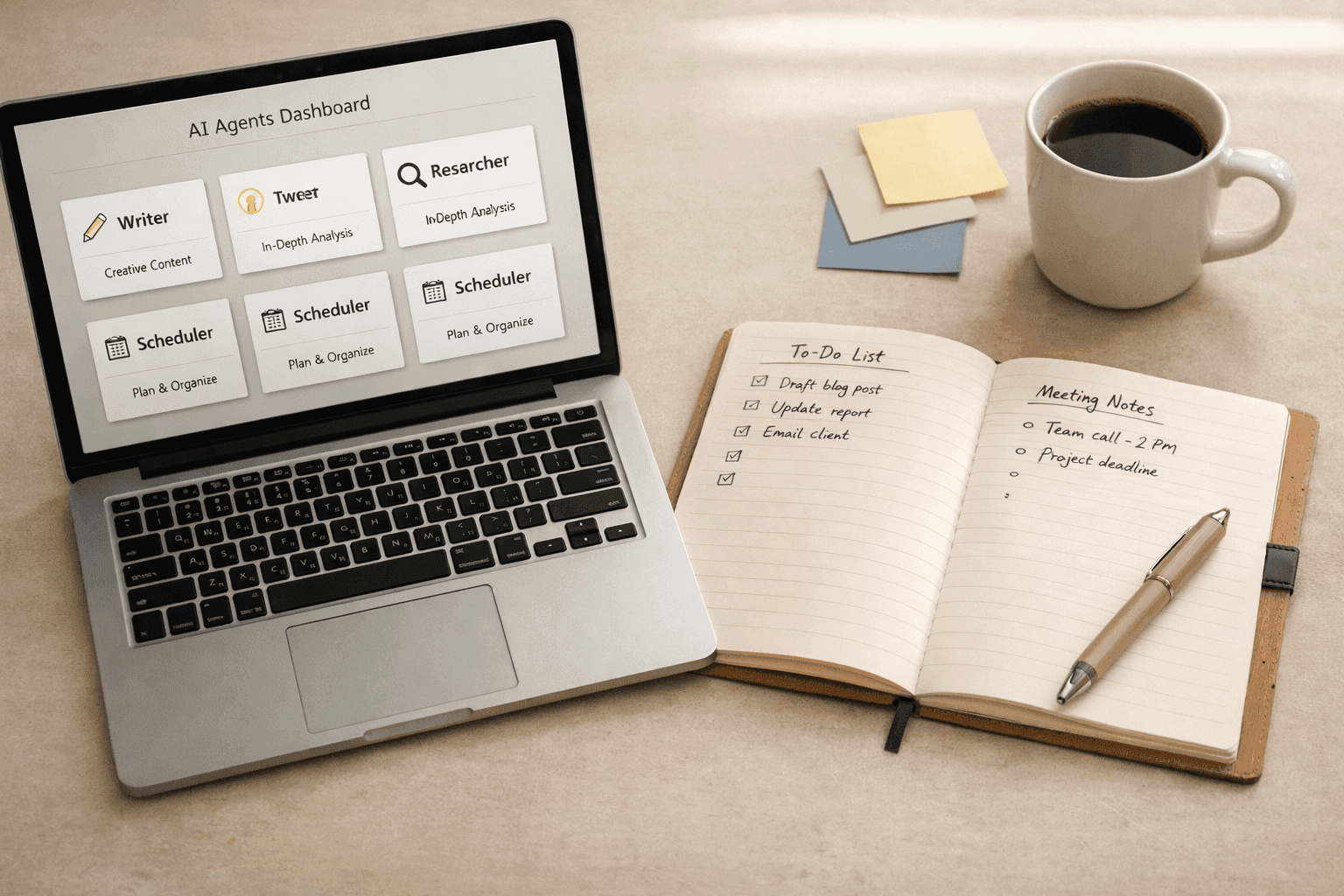
The demos are always good.
Smooth interfaces, fast outputs, agents that seem to understand exactly what you need. Then you get back to your actual work, a half-finished campaign brief, a content calendar that needs filling, a dozen browser tabs, and you try to figure out where the tool actually fits.
That gap between the demo and day two is where most AI agent platforms lose people.
This is an honest look at what AI agents for marketers actually do in practice. Not the pitch. The tool.
Before comparing platforms, it helps to be precise about the term.
A traditional AI tool responds to a prompt. You ask, it answers. You take that answer and do something with it.
An AI agent goes further: it breaks a goal into steps, executes those steps in sequence, uses external data or tools along the way, and delivers a result — with limited hand-holding from you. The difference in practice is that an agent can do things like draft a blog post, check it against your brand guidelines, pull in competitor data, and format it for your CMS — as one continuous task, not four separate prompts.
For marketers, that matters because most marketing work is not one task. It's a chain of tasks. The promise of AI agents is that they can carry that chain without you managing every link.
The reality is more specific. What agents handle well, what they require you to still own, and what breaks down under deadline pressure — that varies significantly by platform.
What it is: A Paris-based platform (launched 2024) that offers 350+ pre-built AI agents — called "Mates" — designed to act as specialized coworkers rather than general-purpose tools. A no-code Agent Factory lets teams build custom agents without writing code. Integrates with Slack, Microsoft Teams, Google Chat, Chrome, and email.
What it does well:
The breadth of pre-built Mates is the clearest differentiator. Instead of prompting a general AI to act like a content strategist, you assign a Mate that's already configured for that role — with specific behaviors, knowledge access, and output formats baked in. For teams that don't want to spend time building workflows from scratch, that's a real time saver.
The integration layer is also practical. A Mate that can pull from your internal documents and drop outputs directly into Slack is genuinely useful for distributed teams where context lives across multiple tools.
Where it gets complicated:
The enterprise orientation means the onboarding curve is steeper than it looks. Connecting your knowledge sources, configuring the right Mates for your specific workflows, and getting consistent output quality across 350+ options takes real setup time. This is not a tool you deploy on a Monday and trust with client work by Friday.
For solo marketers or very small teams, the depth of the platform can feel like overhead. The value compounds when multiple people are sharing Mates and building on each other's configurations — less so when you're the only one in the system.
Who it's actually for: Mid-size to larger marketing teams that want a centralized AI layer across communication tools, have someone willing to do proper setup and governance, and need multiple agents handling distinct workstreams simultaneously.
Relevance AI positions itself as a low-code builder for custom AI agents — "digital workers" — with a marketplace of templates for marketing roles like BDR outreach, lead scoring, and content distribution.
The honest read: it's genuinely powerful if you have a specific workflow that off-the-shelf tools don't cover. The multi-agent orchestration — multiple agents working simultaneously on interconnected tasks — is real and works. The catch is that extracting that power requires more technical comfort than "low-code" implies. If you're a beginner marketer without someone technical alongside you, budget more time for the learning curve than you expect.
Best fit: Growth and GTM teams with defined, repeatable workflows and someone willing to spend time configuring the system properly.
Sintra offers 12 pre-built AI "helpers" covering copywriting, SEO, social media, email, and customer support — all accessible on one subscription starting around $39/month. A centralized Brain AI stores your brand guidelines, documents, and preferences so the helpers stay consistent across tasks.
The honest read: for a solo marketer or a founder doing their own content, Sintra removes a lot of context-switching friction. It is not going to replace a dedicated content team. The helpers are capable within their defined lanes and fall short when tasks get complex or require real judgment. The gamified interface is either motivating or mildly irritating depending on your taste.
Best fit: Solopreneurs, early-stage startups, and marketers managing everything themselves who want a single affordable entry point into AI-assisted workflows.
Noimosai pitches itself as an autonomous marketing team: agents covering growth strategy, competitor intelligence, social listening, SEO, and social media publishing — all in one platform. The positioning is explicitly "AI team," not "AI tool."
The honest read: the scope is ambitious and the capability is real for teams willing to hand over significant autonomy. The risk is the same risk that comes with any highly automated system — when it gets something wrong, it can get it wrong at scale before anyone notices. For marketers who want to stay close to every output, the autonomous framing may feel like too much distance from the work.
Best fit: Medium to large marketing teams or agencies that need coverage across multiple channels, have clear brand guidelines the system can follow, and trust the output enough to reduce manual review.
ContentStudio is a social media management platform with AI-powered content creation layered in — caption generation, hashtag optimization, AI image creation, multi-platform scheduling, and cross-platform analytics in one dashboard.
The honest read: this is the most approachable tool on this list for a beginner. It is also the most limited in scope — it is built for publishing and scheduling, not for end-to-end marketing automation. If your primary pain point is keeping social channels active without spending hours on content production, ContentStudio solves that problem cleanly. It is not an AI agent platform in the same sense as the others here — closer to a smart content calendar with AI assistance.
Best fit: Social media managers, content teams, and small agencies focused on multi-platform publishing who want AI support without the complexity of a full agent platform.
| Your situation | Worth looking at |
|---|---|
| Mid-size team, multiple tools, need agents across Slack/Teams | allmates.ai |
| Specific repeatable workflow, some technical comfort | Relevance AI |
| Solo or small team, tight budget, broad coverage | Sintra AI |
| Want full autonomous marketing ops, large team | Noimosai |
| Content publishing is the main pain point | ContentStudio |
The honest follow-up question for any of these tools: what happens when the output is wrong? Who catches it, and how long does that take? The answer to that question matters more than any feature comparison.
AI agents for marketers have moved past proof-of-concept. Platforms like allmates.ai and its alternatives are capable of handling real work — content drafts, research, scheduling, lead qualification — in ways that were not practical two years ago.
What they have not replaced: editorial judgment, campaign strategy, and the work of knowing what your audience actually needs. An agent that produces five blog post drafts quickly is useful. An agent that knows which one is worth publishing is not here yet.
The teams getting the most out of these tools right now are the ones who have been precise about where human judgment stays in the loop and where agents can run without it. That boundary is different for every team and every workflow.
Start there. Not with the demo.
Tested and reviewed for marketers navigating AI adoption without time to read every launch thread.
Meta prompting and step-back prompting allow AI models to collaborate, boosting reasoning and reliability in complex tasks
Compare OpenClaw, NanoBot, and PicoClaw — three open-source AI agents. Find the right one for your hardware, use case, and security needs in 2026.

Best AI Agents for Beginners 2026 (No Coding Needed)

Best AI Agents 2026: What Works for Small Teams

The Best AI Tools to Run a One-Person Business in 2026 (No Staff, No Code)

Agentic AI Market Size 2026: The $139B Boom Explained

GPT-5.4 shipped March 5, 2026 with native computer use, scoring 75% on real desktop tasks vs. 72.4% human baseline. Most people will prompt it like a chatbot. Here is how to actually get results.

WordPress.com added write access for AI agents in March 2026. After two weeks testing it for editorial drafts, it saves time on the parts you'd expect — and falls apart where it matters most.

ARC-AGI-3 launched March 26, 2026. Every frontier model scored below 1%: Gemini 3.1 Pro Preview led at 0.37%, GPT-5.4 at 0.26%. Here’s what the interactive agentic benchmark reveals about current AI reasoning limits.

Newsquest runs up to 30 AI-drafted stories a day via 30 AI-assisted reporters. Reuters Institute: 67% of publishers haven't saved jobs from AI yet. Here's what the workflow actually looks like.

Z.AI's GLM-5.1 scored 58.4 on SWE-Bench Pro, edging GPT-5.4 and Claude Opus 4.6 by less than 1.1 points. The benchmark lead is real — the hardware requirement to run it locally is not consumer-grade.

AI agents are pitched as the thing that finally automates the grunt work of API integration. The evidence from controlled studies and production deployments tells a messier story — real gains on narrow tasks...

Combining multiple AI coding tools into a unified workflow is delivering measurable productivity gains for developers who get the configuration right. The efficiency argument is real — but the integration overhead is...